10 Best Retro Arcade Games Ever Made
What separates a great arcade game from a truly timeless one? A countdown of the 10 classics that defined the golden age of the arcade — and why they still hold up today.
What Makes a Retro Arcade Game Timeless?
The golden age of arcade games ran roughly from the late 1970s through the early 1990s, and in that short window developers figured out something that game designers have been chasing ever since: the perfect balance of simplicity and depth. The best retro arcade games could be learned in thirty seconds and mastered over a lifetime. They demanded skill, rewarded practice, and delivered just enough punishment to keep you fishing for one more quarter.
A truly timeless arcade game does not just play well — it feels right. The feedback loop between player input and on-screen action is immediate and satisfying. The cabinet artwork pulls you in before you even drop a coin. The sound effects become part of your memory. The games below earned their legendary status through a combination of innovation, playability, and cultural impact that no amount of modern polish has been able to replicate. They are not just historically significant; they are genuinely fun in ways that hold up on original hardware to this day — which is exactly why you will find so many of them at our bar and arcade in Raleigh NC.
At Super Rad Retro Lounge in Raleigh, we have obsessed over these games for years. Every cabinet on our floor runs on its original board with a real CRT monitor — the same setup that made these games legends in the first place. Here is our definitive countdown of the 10 best retro arcade games ever made.
The Countdown: 10 to 6
#10 — Frogger (1981)
Konami's Frogger looked absurd on paper: guide a frog across a busy highway and a treacherous river to safety. Yet the moment you touched that joystick, the tension was real. Frogger succeeded because it layered two completely different obstacle puzzles into a single screen and forced you to manage both simultaneously. The highway section was pure reflex; the river demanded timing and planning. Its bright, cheerful graphics and instantly recognizable sound effects masked a game that punished hesitation without mercy. Frogger sold over 20 million units and remains one of the most imitated game concepts in history. It is the rare arcade game that feels just as fresh at 45 as it did in 1981.
#9 — Asteroids (1979)
Atari's Asteroids was one of the first arcade games to make players feel truly alone in space — and not in a comfortable way. Your tiny triangular ship floated in a field of tumbling rocks, and every shot you fired risked splitting a large asteroid into two smaller, faster ones. The game's vector graphics were unlike anything else on the floor in 1979: crisp white lines on a black screen that somehow conveyed more personality than fully colored sprites. Asteroids introduced the high-score leaderboard to mainstream gaming culture and became one of the best-selling arcade cabinets of its era. The hyperspace button — a panic move that teleported you to a random spot on screen, possibly into a rock — was a stroke of genius that kept even experienced players nervous.
#8 — Galaga (1981)
Namco's Galaga took everything Galaxian had done and turbocharged it. Enemy insects flew in precise, choreographed formations before diving at your ship in patterns that felt almost musical. The defining mechanic — letting the boss Galaga capture your ship with a tractor beam so you could rescue it and fight with a dual fighter — was one of the most brilliant risk-reward decisions in arcade history. Players who mastered the dual-fighter configuration could double their firepower and rip through enemies at a pace the developers clearly did not anticipate. Galaga's blend of pattern recognition, precise shooting, and that ever-present temptation to sacrifice your ship for the upgrade cemented it as one of the most replayable shooters ever built. It is a top-tier entry in the arcade classics canon for good reason.
#7 — Ms. Pac-Man (1982)
Midway's Ms. Pac-Man improved on the original in nearly every measurable way, which is a remarkable thing to say about a sequel to one of the greatest games ever made. The mazes changed as you progressed instead of repeating. The ghosts moved less predictably, making pure pattern memorization less reliable and raw skill more important. The fruit bounced across the screen unpredictably rather than sitting in one spot, rewarding quick reactions. Even the cut scenes between mazes told a charming little love story that gave the arcade something it had rarely attempted before: narrative. Ms. Pac-Man sold over 125,000 cabinets in the United States alone and is widely considered the better game by serious players. It is also a staple of any authentic classic arcade collection.
#6 — Tetris (1988)
Alexey Pajitnov's Soviet puzzle game reaching Western arcades in 1988 was one of gaming's great cultural moments. Tetris is perhaps the only game on this list with a legitimate claim to being objectively perfect. Seven geometric pieces. One well. Gravity. The genius is in how the system generates emergent complexity from nearly nothing: the deeper you get, the faster the pieces fall, and the more desperate and creative your solutions become. The psychological hooks — the near-miss of almost clearing four lines, the panic of an S-piece when you need an I-bar — are so powerful that researchers have identified a "Tetris effect" where players report seeing falling shapes when they close their eyes. Decades later, Tetris remains the benchmark against which every puzzle game is measured. On a real arcade cabinet with a proper joystick, it is an experience no phone app can replicate.
The Top Five
The games that defined an era and built the culture of competitive play.
#5 — Mortal Kombat (1992)
Midway's Mortal Kombat arrived like a thunderclap. Where Street Fighter II had introduced the world to the modern fighting game, Mortal Kombat changed the conversation entirely with digitized actors, a dark fantasy mythology, and — most infamously — fatalities. The finishing moves were shocking enough to spark congressional hearings and ultimately create the ESRB ratings system, which is about as outsized a cultural impact as a video game can have. But beneath the controversy was a legitimately excellent fighting game with tight controls, memorable characters, and enough hidden moves and secrets to keep players in arcades for months. Sub-Zero, Scorpion, and Johnny Cage became icons of 90s pop culture. The game proved that shock value and genuine craft were not mutually exclusive, and it launched one of the most enduring fighting game franchises in history. You can find out more about the games we carry on our games page.
#4 — Street Fighter II (1991)
Capcom's Street Fighter II did not just define a genre — it created the modern competitive gaming scene. Before Street Fighter II, arcade games were largely solitary experiences. After it, arcades transformed into arenas. Players would line quarters along the edge of a cabinet to reserve their turn, study each character's move set like a martial arts student studying kata, and develop deep rivalries with regulars. The six-button layout, the charge characters versus the motion characters, the distinct national styles of the eight original fighters — every decision Capcom made felt deliberate and considered. Special move inputs that required precise joystick motions added a skill ceiling that kept players grinding for years. Street Fighter II is probably the single most influential arcade game in history after Pac-Man, and playing it on original hardware on a proper six-button stick is as close to a religious experience as arcade gaming gets. Learn more about authentic arcade experiences in our guide to real arcade vs. multicade machines.
#3 — Donkey Kong (1981)
Nintendo's Donkey Kong introduced the world to a carpenter named Jumpman — who would later become Mario — and in doing so invented the platformer. Before Donkey Kong, arcade games were largely about shooting or avoiding things on a flat plane. Donkey Kong added verticality: a multi-story construction site full of rolling barrels, bouncing fireballs, and elevators, all presided over by a barrel-hurling gorilla at the top. The game's four distinct stages each presented a different kind of challenge, which was unprecedented for 1981. Its narrative framing — rescue the girl, defeat the villain — was simple but gave the game a story arc that kept players emotionally invested. Donkey Kong became a cultural phenomenon, inspired one of the great competitive gaming rivalries of the era (documented in the film The King of Kong), and launched two of gaming's most beloved franchises. On a restored original cabinet, the low-resolution sprites and simple sound cues still deliver remarkable tension.
#2 — Space Invaders (1978)
Taito's Space Invaders may be the most consequential video game ever made. Before its arrival, video games were a curiosity; after it, they were an industry. Space Invaders sold so many arcade cabinets that it reportedly caused a coin shortage in Japan. Its core mechanic — a grid of alien invaders marching inexorably downward while speeding up as their numbers thinned — created the definitive pressure-cooker experience that nearly every arcade game since has tried to replicate. The four destructible bunkers added a resource-management layer that rewarded players who thought ahead. The occasional mystery ship drifting across the top of the screen offered bonus points for those with quick enough reflexes. Space Invaders proved that a simple concept with perfect execution could captivate millions of people, and it set the creative and commercial template for an entire industry. Playing it today, on original hardware with the original cabinet artwork, is a direct connection to the moment video games became real. Read our deep dive on why CRT arcade machines matter to understand why original hardware makes all the difference.
#1 — Pac-Man (1980)
There was never really a debate. Namco's Pac-Man is the greatest retro arcade game ever made, and the argument for it is almost embarrassingly complete. It was the first video game to become a genuine mainstream cultural phenomenon, crossing over from arcades into music, television, merchandise, and the cultural consciousness in a way no game had before. It was the first game specifically designed to attract female players, with its non-violent theme and cute characters — a decision that doubled the audience for arcade games overnight. It introduced the concept of the villain with personality: Blinky, Pinky, Inky, and Clyde each moved by distinct rules, and mastering those rules was the key to mastering the game. The satisfying waka-waka of Pac-Man eating dots, the terrifying silence when a ghost turned blue, the triumphant music of clearing a board — every sound and visual detail was considered. Pac-Man has been played more than any other coin-operated arcade game in history. On a restored original cabinet, with the original boards running warm and a real CRT glowing in the dark, it is perfect. You can see our restoration process to understand what goes into bringing a cabinet like this back to its original condition.
Play These on Authentic Restored Hardware in Raleigh
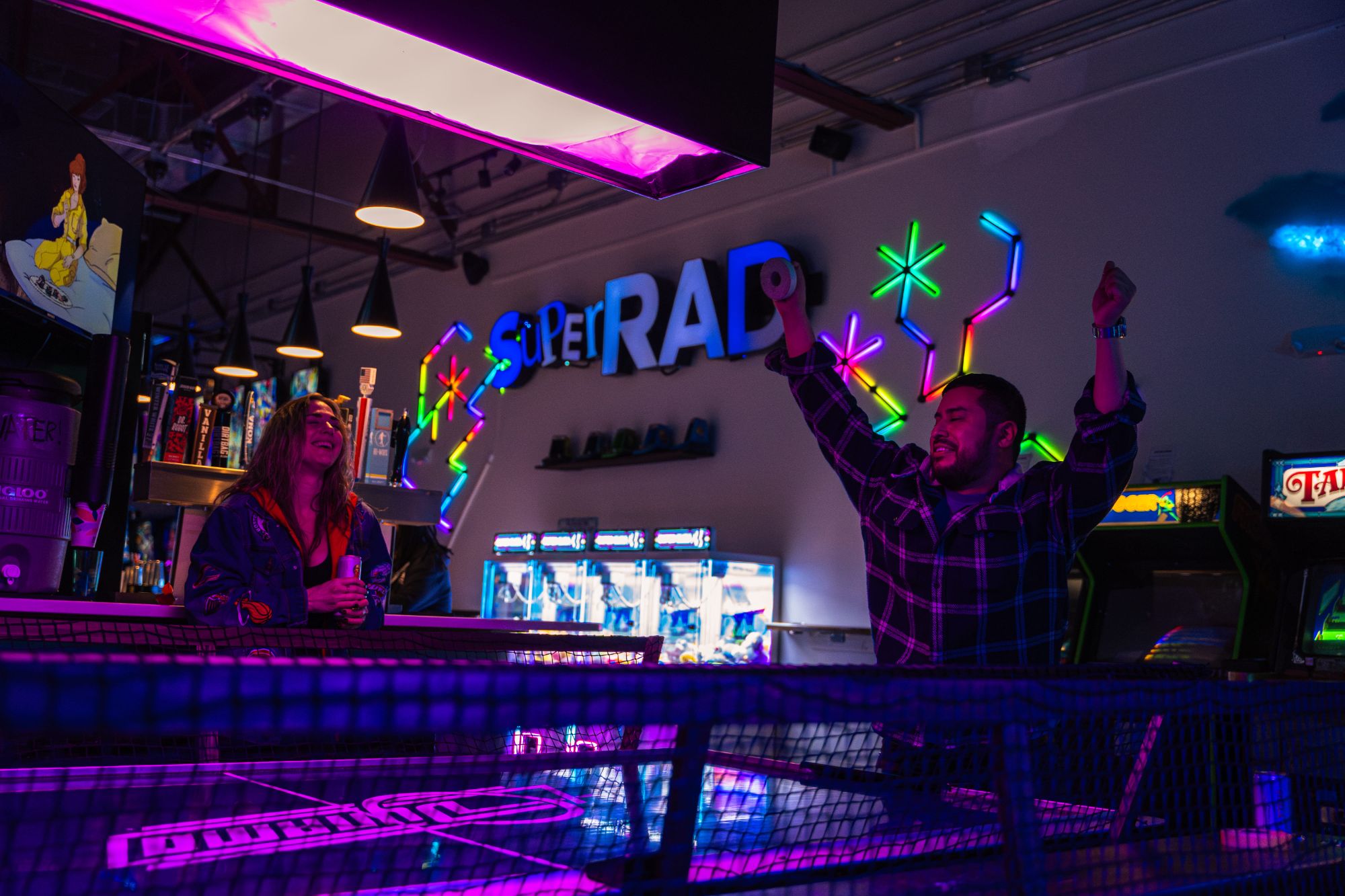

Reading about these games is one thing. Playing them the way they were meant to be played is something else entirely. At Super Rad Retro Lounge on Glenwood South in Raleigh, every cabinet on our floor is fully restored with its original boards and original CRT monitor — the same hardware that made these games legendary in the first place.
We do not use multicades or emulation. We do not swap out the CRTs for flat screens. We find original cabinets, strip them down, and bring them back to factory condition, because there is simply no substitute for the real thing. The scan lines, the phosphor glow, the exact input lag of a genuine arcade PCB — these are not aesthetic choices, they are the game. Modern displays and emulators get close, but close is not the same.
We have more than 30 fully restored arcade games on the floor, covering everything from the earliest golden-age shooters to the fighting game revolution of the early 90s. Whether you want to chase a Pac-Man world record, finally learn the Hadouken, or show your kids what gaming looked like before the internet — this is where you do it.
Curious about what goes into a real restoration? See our restorations page and learn why we think CRT machines matter. Want to understand the difference between what we do and a multicade? Read real arcade vs. multicade.
The Experience
More than games — an atmosphere that takes you back.
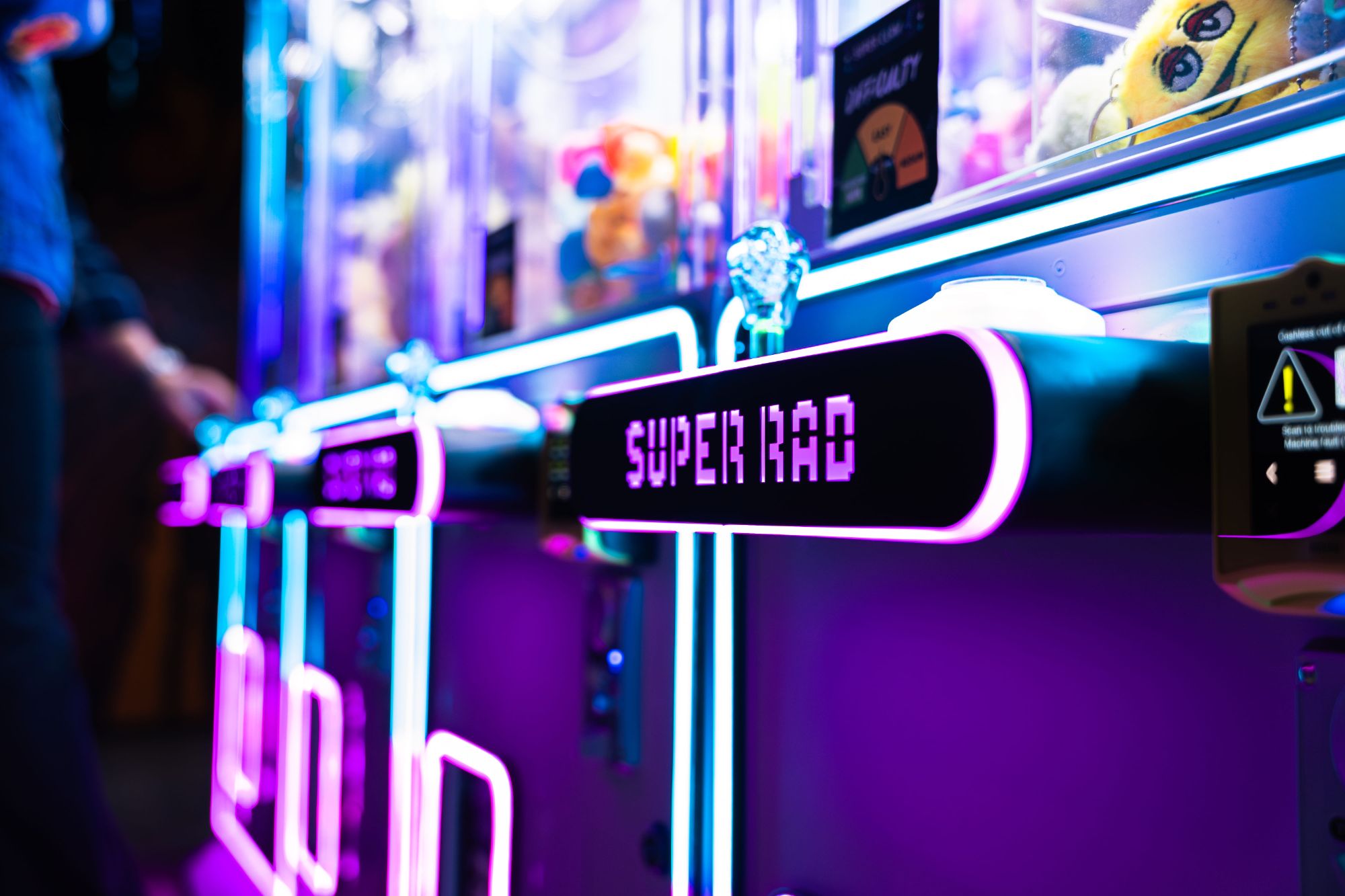
The Real Thing
Original boards, original CRTs, original cabinet art. No emulation, no shortcuts. Just the games as they were designed to be played, in a room that smells like nostalgia.
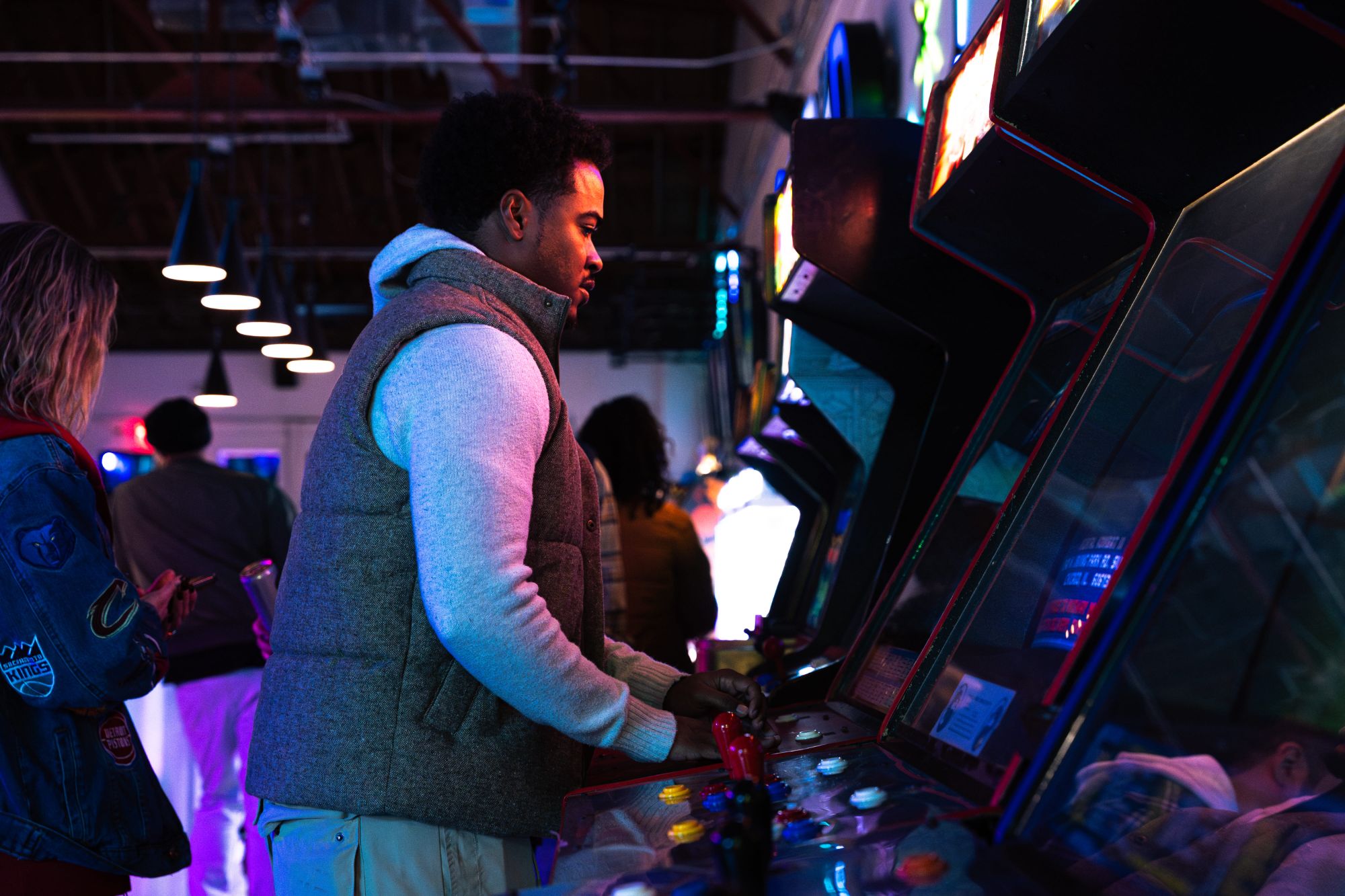
A Full Bar
Craft cocktails, local draft beer, and zero-proof options. Retro gaming and great drinks are a natural combination — especially when the drinks are actually good.
Weekly Events
Arcade tournaments, retro trivia nights, themed parties, and more. There is almost always something happening at Super Rad beyond just showing up and playing.
See the event calendar →Frequently Asked Questions
What is the best-selling arcade game of all time?
Pac-Man is the best-selling coin-operated arcade game in history, with over 400,000 cabinets sold worldwide. It was the first video game to cross over into mainstream popular culture as a genuine phenomenon, spawning music, merchandise, a television cartoon, and decades of sequels. Space Invaders, released two years earlier, was the first game to create a genuine arcade craze and is considered the commercial foundation of the industry — but Pac-Man surpassed it on every sales metric.
What is the oldest arcade game?
The earliest electro-mechanical arcade machines date to the 1930s, but the first true video arcade game is generally considered to be Computer Space (1971), designed by Nolan Bushnell and Ted Dabney before they founded Atari. Pong (1972) was Atari's first major commercial success and is more widely remembered as the game that launched the coin-operated video game industry. The golden age of arcade gaming — the era that produced all ten games on this list — is typically dated from 1978 (Space Invaders) through the early 1990s.
Can I play these classic retro arcade games in Raleigh NC?
Yes. Super Rad Retro Lounge at 106 Glenwood Ave in Raleigh carries more than 30 fully restored classic arcade cabinets on original hardware with original CRT monitors. Many of the games on this list — including Pac-Man, Donkey Kong, Galaga, Mortal Kombat, Street Fighter II, and more — are on the floor and available to play any time we are open. We are family-friendly until 8 PM and 21+ after that.
What made arcade games from the 1980s so addictive?
The best 1980s arcade games were engineered for quarters. Every design decision was made to create a compelling loop: easy enough to learn immediately, hard enough to fail quickly, rewarding enough to want another try. The lack of save states or continues meant each life mattered. The public leaderboard meant your score was visible to everyone in the room. The cabinet art and sound design created an atmosphere before you even started playing. Together, these elements created feedback loops that modern free-to-play mobile games have spent billions trying to replicate — mostly without matching the elegance of the originals.
Are there differences between playing on original hardware vs. emulation?
Yes — significant ones, especially for the games on this list. Original arcade PCBs run at slightly different timings than emulators, and the CRT monitors they were designed for have a fundamentally different visual character than LCD or OLED screens. Scan lines, phosphor persistence, and the curvature of a real CRT change how fast-moving sprites look and feel. Controllers and joysticks have distinct actuation weights and throw distances. These are not merely sentimental preferences — they affect how the game plays. Read our guide to why CRT arcade machines matter for a deeper dive.
Come Play Them in Person
The ten games above are not museum pieces. They are living, playable experiences — and most of them are right here in Raleigh on original hardware, waiting for you to put a token in and take your shot. Whether you grew up on these or you are discovering them for the first time, there is nothing quite like playing them the way they were meant to be played: on a real cabinet, with a real joystick, in a room full of people who get it.